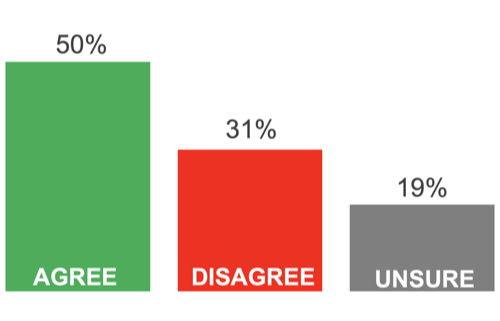
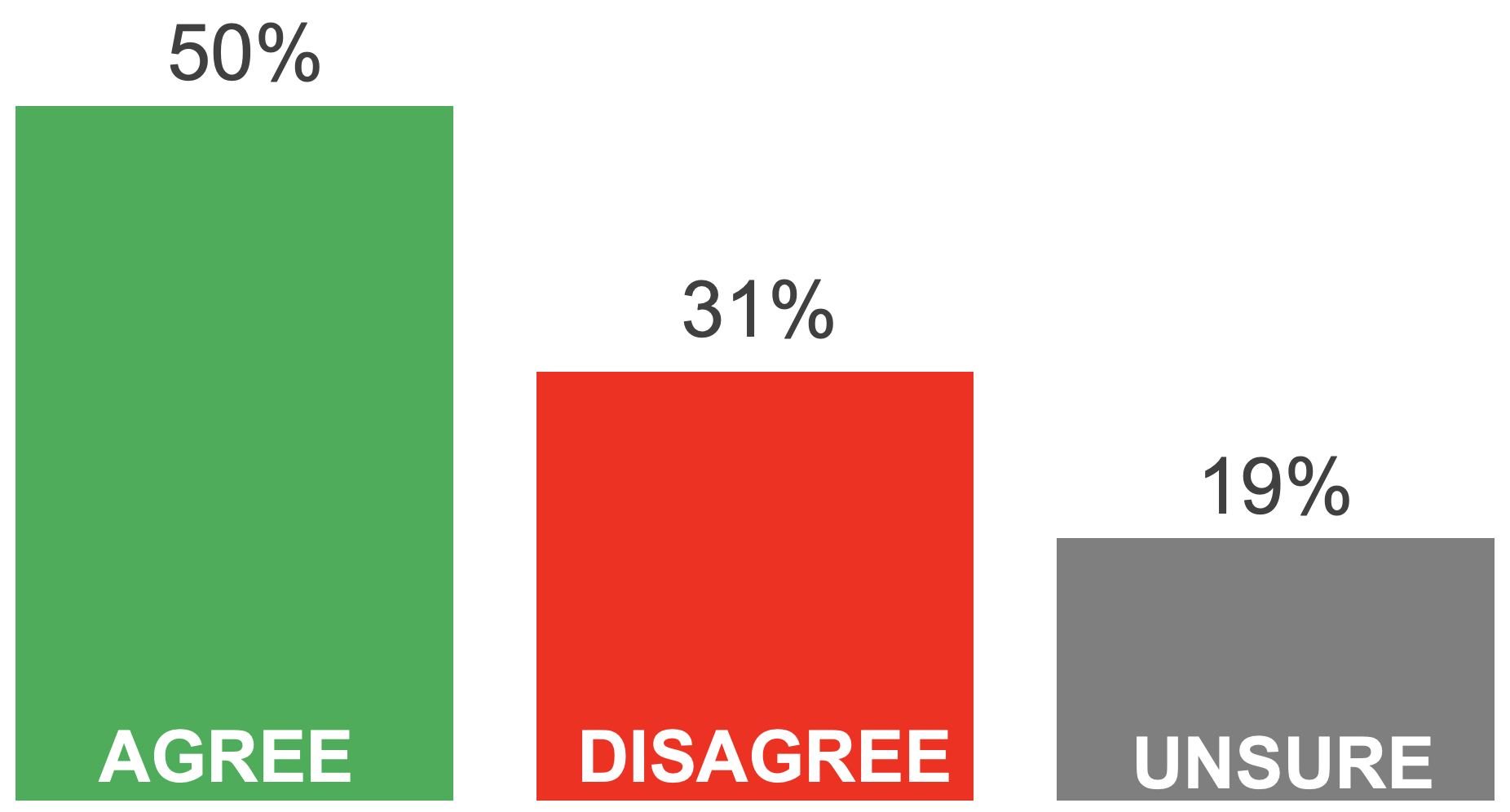
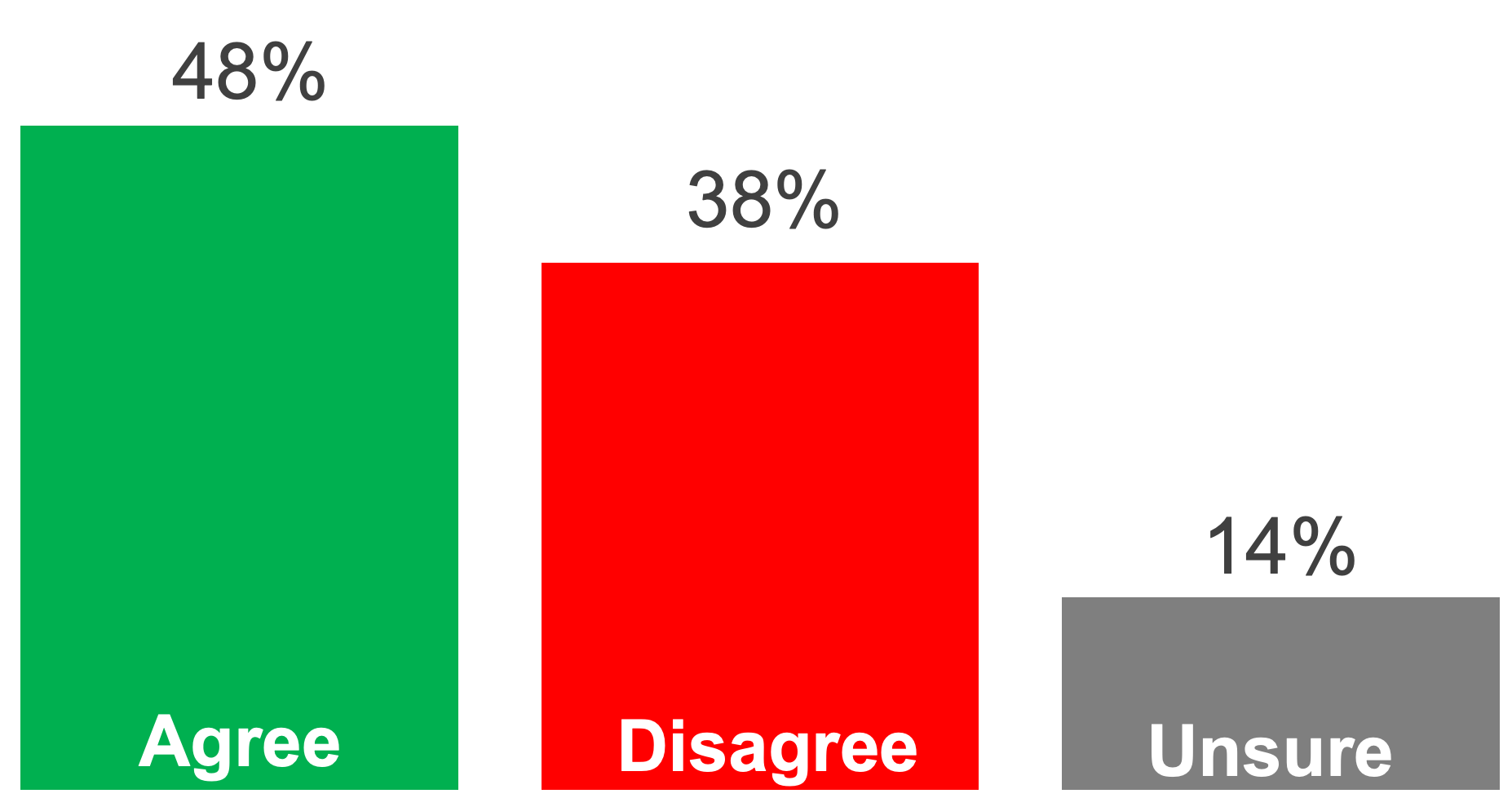
Agree or disagree: It is time for parents to take back control of our schools.
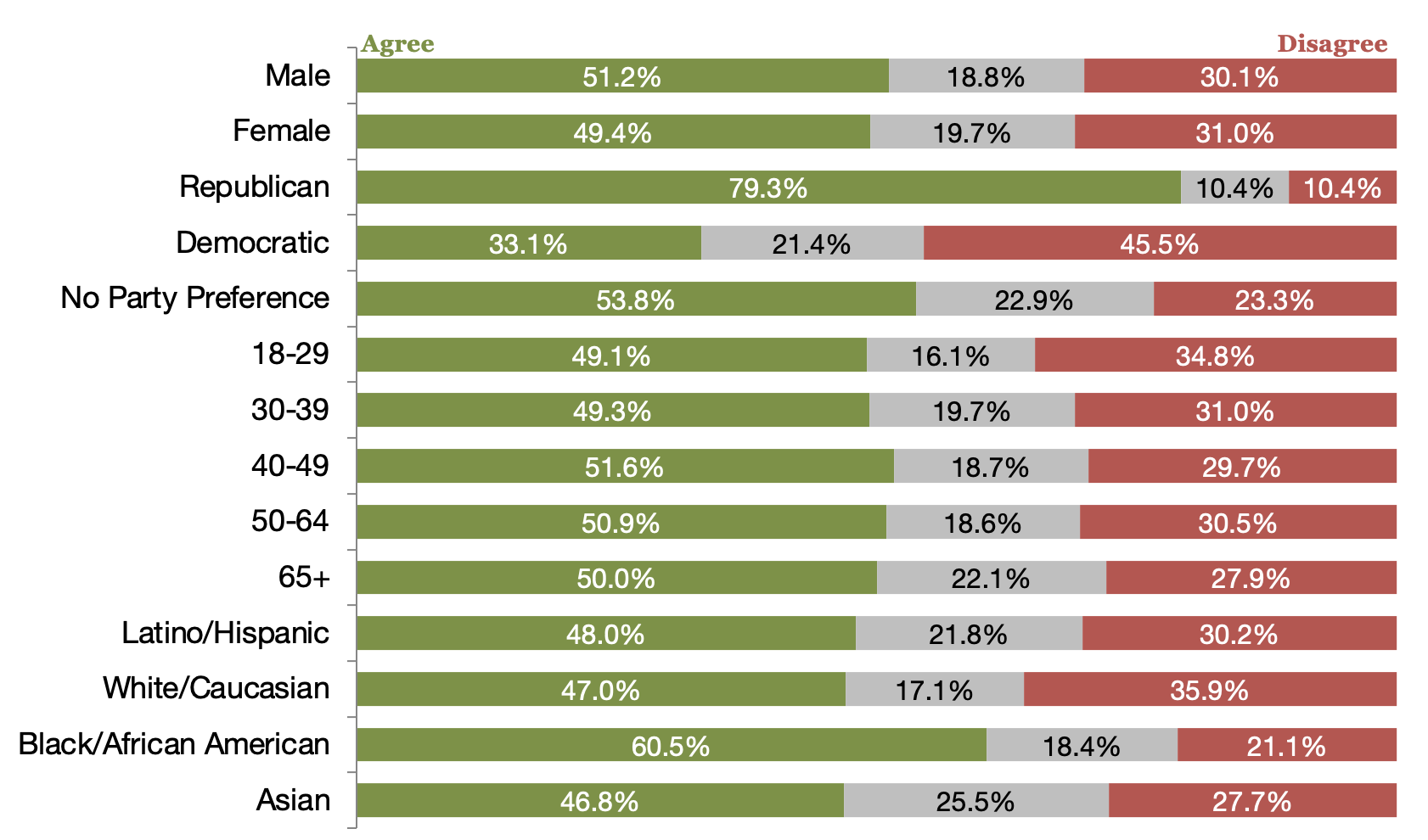
A majority of California voters say it’s time for parents to “take back control of our schools.” This includes 54% of independent voters and 79% of Republicans. And while small in number, black voters also broadly agree.
A majority of parents, including 56% of those with school-age children say they want change.
The multi-mode poll was conducted by telephone and online among 900 California voters from November 12 – 18, 2021. A survey of this size yields a margin of error of +/-3.3% and a 95% confidence level. This survey question was not sponsored by a third party, the results are being released for public interest.
Probolsky Research is a non-partisan Latina- and woman-owned research firm with corporate, election, government, and non-profit clients.
https://www.probolskyresearch.com/wp-content/uploads/2021/11/Parents-Take-Back-Control-featured.png500500Probolsky Researchhttps://www.probolskyresearch.com/wp-content/uploads/2024/08/Logo.pngProbolsky Research2021-11-23 06:35:392021-11-23 14:12:49Parents: It’s Time to Take Back Control of Our Schools (NEW POLL)
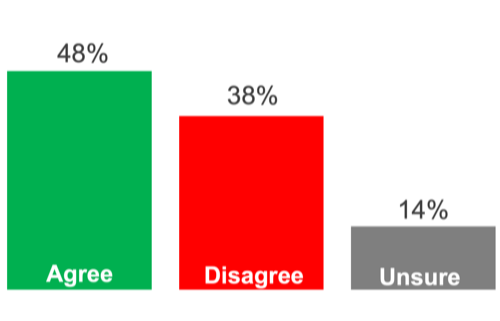
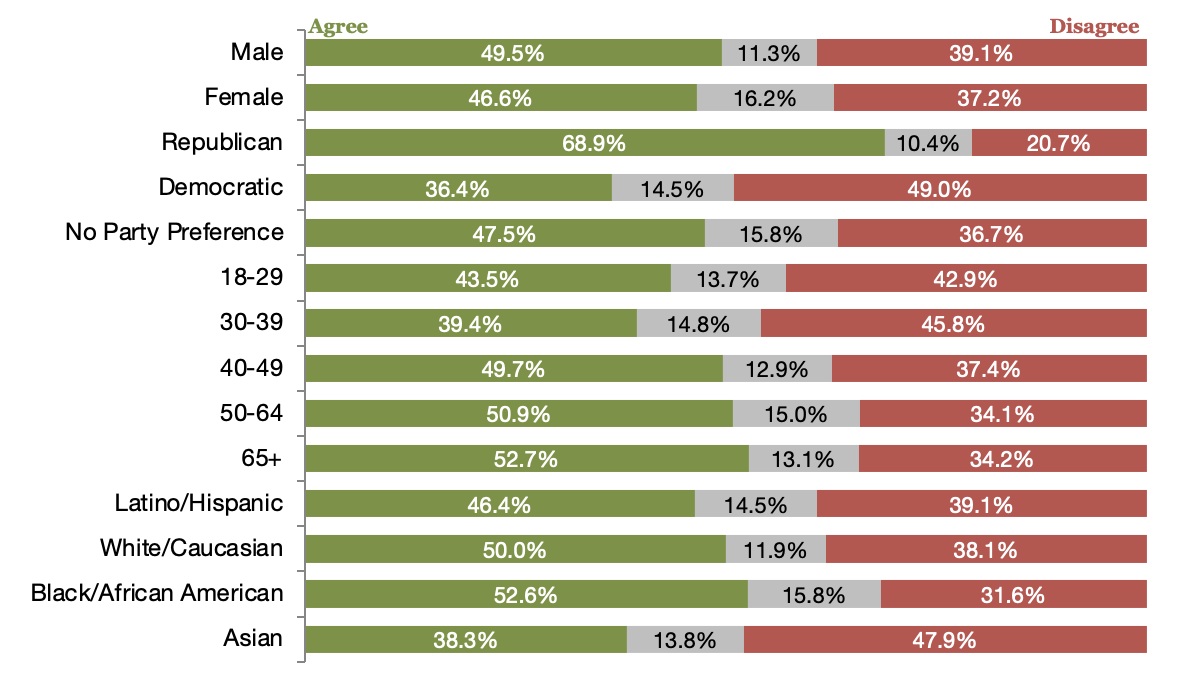
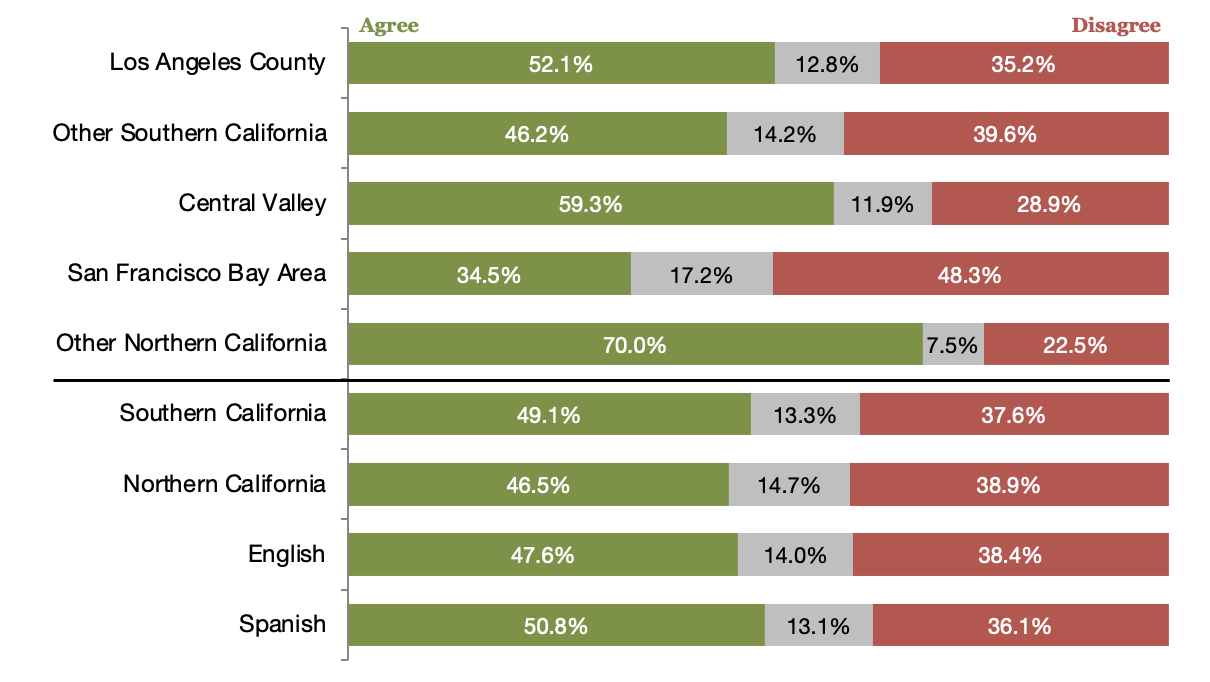
QUESTION: Agree or disagree: I am worried that a complete breakdown in American society could happen in my lifetime where no one shows up to work, armed mobs roam the streets, and the government cannot continue to operate.
The results are even more dramatic among Republicans, 69% of whom say they are worried, and those fifty and older who say American society is on the brink. Black voters too.
Full majorities in Los Angeles County, the Central Valley and Northern California also believe we are doomed, as do a majority of those who prefer to speak Spanish.
The multi-mode poll was conducted by telephone and online among 900 California voters from November 12 – 18, 2021. A survey of this size yields a margin of error of +/-3.3% and a 95% confidence level. This survey question was not sponsored by a third party, the results are being released for public interest.
Probolsky Research is a non-partisan Latina- and woman-owned research firm with corporate, election, government, and non-profit clients.
https://www.probolskyresearch.com/wp-content/uploads/2021/11/Societal-Breakdown-Thumb.png500500Probolsky Researchhttps://www.probolskyresearch.com/wp-content/uploads/2024/08/Logo.pngProbolsky Research2021-11-19 16:06:382021-11-20 16:58:38Society Will Completely Break Down in Our Lifetime says a Near Majority of California Voters
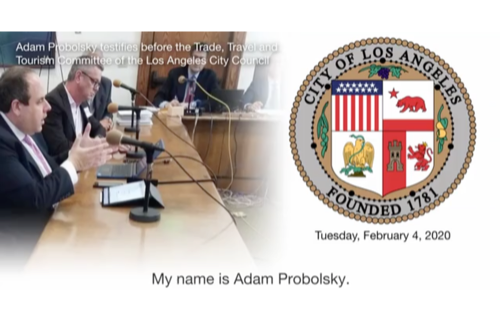
Here is a great example of how polling is used in the advocacy/lobbying process. When LAX banned taxis and ride share companies from picking up curbside, we were engaged to conduct a poll and Adam Probolsky testified before the LA City Council Tourism Committee about our findings. Click below to listen in.
https://www.probolskyresearch.com/wp-content/uploads/2021/09/Adam-Probolsky-Testifying-at-LA-City-Council-Tourism-Committee-Pic-copy.png500500Probolsky Researchhttps://www.probolskyresearch.com/wp-content/uploads/2024/08/Logo.pngProbolsky Research2021-09-01 18:53:572021-11-30 22:55:16How polling is used with advocacy
In a recent poll, we found that a large majority (75%) of California voters would prefer that Governor Newsom appoint Coastal Commissioners who will prioritize protecting the coast and public access to beaches.
“In a political environment as polarized as it is today, it’s rare to see an issue area with such singular consensus,” said Adam Probolsky, president of Probolsky Research. “When it comes to our oceans, coasts, and beaches, California voters are solidly pro-conservation and they want the governor to appoint Coastal Commissioners that reflect this value.”
This poll was conducted for a coalition of California conservation organizations including Orange County Coastkeeper.
https://www.probolskyresearch.com/wp-content/uploads/2021/04/Coastal-Commission-Appointment.png500500Probolsky Researchhttps://www.probolskyresearch.com/wp-content/uploads/2024/08/Logo.pngProbolsky Research2021-04-08 22:12:462021-04-08 22:38:22Voters: Governor Should Appoint Commissioners who will prioritize protecting the coast
Listen to Adam Probolsky on the Digital Politics podcast talking about our recent Probolsky Research poll on the California Governor Recall Election.
https://www.probolskyresearch.com/wp-content/uploads/2021/03/Digital-Politics.png500500Probolsky Researchhttps://www.probolskyresearch.com/wp-content/uploads/2024/08/Logo.pngProbolsky Research2021-03-25 20:13:042021-03-25 20:15:07Adam Probolsky on Digital Politics podcast
We conducted a California Statewide voter survey on the potential Recall Election of Governor Gavin Newsom.
Probolsky Research is a non-partisan Latina- and woman-owned firm with corporate, election, government, and non-profit clients. We have no client in this Recall Election.
“The governor has higher favorables than unfavorables and the recall would fail if the election was today,” explained Adam Probolsky, president of Probolsky Research on a virtual press conference. “We did find some worrying signs of weakness for Newsom, including sizable recall support from Latino voters.”
The video of the virtual press conference is below the results presentation.
Contact: Adam Probolsky – mobile 949-697-6726, adamp@probolskyresearch.com
Here is the video of our virtual press conference. Thank you to Scott Lay of The Nooner for joining us.
Destination branding is often ineffective without a robust research phase during the branding process. Public sentiment research, competitive research and other types of research are the foundations of the brand strategy and help narrow in on the story that the brand is to tell. Especially as budgets have tightened in response to Covid-19 and other factors, research plays an even more critical role in the process. Research and data help districts, cities, counties and DMOs feel comfortable with and confident in the direction of the brand and its campaigns. Research is what makes branding feel like money well spent.
Both quantitative and qualitative research are important to the branding process. We sometimes see cities place more of an emphasis on the quantitative side, but the reality is that both types of research have value and need to play a role in branding. The balance of each type will be different from project to project, but we believe both should always be employed.
The role of quantitative research
Quantitative research is helpful because it provides hard numbers to reference and compare. We sometimes partner with Probolsky Research, a market research firm based in California, to help us design and implement quantitative research strategies, as we trust their expertise in this area. By conducting statistically valid, multi-modal surveys, we can confidently identify trends, measure sentiments and behaviors, and understand the perception of a destination brand based on data from a representative sample of the place’s population (or a regional population if doing competitive or key market research).
The key benefit of quantitative research is confidence. If done correctly, your data will be representative of the population you survey, and you’ll have better data based on demographic groups (including by geography), so you can be confident in the insights derived from the data. That means public leaders and the public at large will have more confidence in the branding process. You’ll also reach a large number of people fairly easily and can establish benchmarks (like brand awareness in key markets, net promoter scores, etc.) that you can compare year-over-year to ensure the effectiveness of advertising campaigns.
An example of Probolsky Research’s benchmarking work with the City of Napa, California
Quantitative research is also particularly useful when done through an “external” lens — that is, to gauge how outside markets view your destination as a place to visit, move or start a business. You can quickly design a survey that runs in a few key markets, and within a relatively short amount of time, you’ll have a good sense of the way many different regions view your place.
The role of qualitative research
Qualitative research, on the other hand, is much more nuanced. It “summarizes and infers, rather than pin-points an exact truth.” If the role of quantitative research during the branding process is to provide you with the hard numbers you need to back up your decisions, qualitative research illuminates the story of your brand and the people it represents. Focus groups, man-on-the-street style interviews, and casual conversations and observations, while somewhat anecdotal, can help you get a better sense of the feel of the brand, narrow in on the stories of different demographics, and add richness and depth to quantitative data.
QUALITATIVE RESEARCH ILLUMINATES THE STORY OF YOUR BRAND AND THE PEOPLE IT REPRESENTS.BRISA BYFORD – SENIOR STRATEGIST, CIVICBRAND
For example, in our work in Waupaca, Wisconsin, the brand strategy can be summarized by Chain + Main, where Chain is shorthand for all of the outdoor recreation activities the area has to offer, and Main is shorthand for vibrant community activities, restaurants, businesses and more. Connecting the two areas together is critical for economic development in the area, but that strategy would have been hard to hone in on with just a survey.
The same can be said for our work in Heartland Lakes, Minnesota. The challenge of that project involved uniting several different small communities and marketing them as part of a larger area. The previous name for the area was a mouthful and didn’t resonate with a lot of people. Only through our qualitative research, when we were literally standing on the Heartland Trail that physically connects the area’s communities, did we realize the place should be called Heartland Lakes. It was a lightbulb moment that wouldn’t have had the same effect in survey data.
There is extreme value in how much qualitative research connects to public engagement. Your efforts to engage with the public and talk to them about the project have a direct effect on community buy-in and the project’s outcome. If the branding process is done behind closed doors, it’s a lot easier for people to dissent or distract from the message. However if your qualitative research extends a hand to the public and invites them into the process, you’ll create brand champions that will not only provide you with critical feedback, but rally people (and money) around the brand. In this way, qualitative research can have more of an “internal” lens.
The role of equity in research
Think of these types of research as a Venn diagram, with quantitative on the left on qualitative on the right. In the middle, where the two circles overlap, lies the concept of equity, which is something we talk a lot about at CivicBrand. We pride ourselves on having an equitable approach to research and public engagement. That means we make an extra effort to reach the demographics that are traditionally underserved or hard to reach. With quantitative research specifically, we oversample in order to get a clearer picture of the perceptions and attitudes of certain demographics (foreign language speakers, for example). With qualitative research, we identify different groups that may be hard to reach and then go directly to them. At that point it’s no longer a random sample, but hearing their stories is necessary to telling the bigger, brand story.
The role of both types
If quantitative research is the analytical left brain, qualitative research is the creative right brain. By combining both methods, you get the most accurate read of human behavior. But if you lean too far to one side, you miss out on the value of the other method. Stories collected in qualitative research should always be validated as being relatable to the broader audience by testing them in a survey.
STORIES COLLECTED IN QUALITATIVE RESEARCH SHOULD ALWAYS BE VALIDATED…BY TESTING THEM IN A SURVEY. ADAM PROBOLSKY – PRESIDENT, PROBOLSKY RESEARCH
It’s also important that you don’t forget your audience. Research should be engaging, regardless of type. Any data you collect should be usable and actionable, and it should guide the brand strategy but not rule it.
At the end of the day, if something produces clarity and insight, regardless of the type of research, it’s valuable. We believe it’s better to focus on the insight itself (and what you can do with the brand because of it) than the way it was discovered.
Listen to CivicBrand CEO Ryan Short, CivicBrand Senior Strategist Brisa Byford, and Probolsky Research President Adam Probolsky discuss this topic in more detail on the CivicBrand podcast.
https://www.probolskyresearch.com/wp-content/uploads/2021/02/CivicBrand-FG-Pic-copy.png500500Probolsky Researchhttps://www.probolskyresearch.com/wp-content/uploads/2024/08/Logo.pngProbolsky Research2021-02-19 16:22:032021-02-26 18:29:36Quantitative and Qualitative Research in the Branding Process
Thank you to our partners at Civic Brand for talking today about how research can help drive brand messaging and strategy. Ryan Short, CEO and Brisa Byford, senior strategist are pros.
https://www.probolskyresearch.com/wp-content/uploads/2021/02/eyes_logo.jpg800800Probolsky Researchhttps://www.probolskyresearch.com/wp-content/uploads/2024/08/Logo.pngProbolsky Research2021-02-13 00:49:102021-02-13 00:55:42Adam Probolsky on the Eyes on the Street Podcast
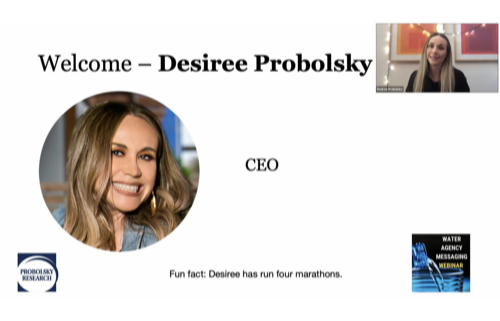
Today we conducted our first water agency messaging webinar of 2021. Alfonso Ordaz, one of our research analysts, and Desiree Probolsky our CEO, kicked off the 30-minute session and Adam Probolsky provided the key insights and answered participant questions.
These are not your typical messages. It’s worth watching and reaching out for a private briefing.
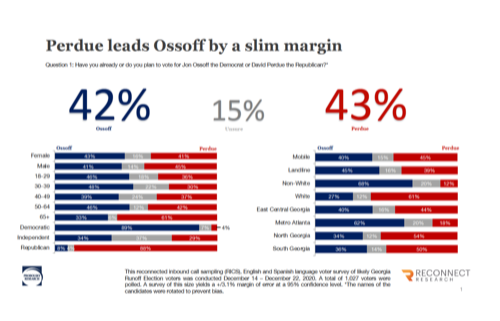
Reconnect Research, in partnership with Probolsky Research conducted a redirected inbound call sampling (RICS), English and Spanish language telephone survey among likely Georgia Senate Runoff Election voters.
Our poll finds Republican Senator Perdue with a 1% point lead over Democratic challenger Ossoff, and Democratic challenger Warnock with a 1% lead over Republican Senator Leoffler. There are 15% undecided in both races.
“With the sizable undecided voters, either candidate could win in these two seats,” explained pollster Adam Probolsky. “We found it interesting that both Democratic challengers had the support from 8% of Republican voters. The Republican candidates pull about half that percentage of Democratic voters.”
The poll was conducted for public interest, neither Reconnect Research nor Probolsky Research has a client in the race. Both firms are non-partisan.
Media contact: Adam Probolsky – Probolsky Research – (949) 697-6726 or email: adamp@probolskyresearch.com
https://www.probolskyresearch.com/wp-content/uploads/2020/12/GA-Poll-Pic.png500500Probolsky Researchhttps://www.probolskyresearch.com/wp-content/uploads/2024/08/Logo.pngProbolsky Research2020-12-23 21:49:132020-12-23 21:58:35Perdue and Warnock Lead by the Slimmest of Margins in Georgia Senate Runoff Election