
Why Do Local Government Agencies Conduct Revenue Measure Feasibility Polls?

By Dr. Adam Probolsky
Local government agencies conduct revenue measure feasibility polls to learn whether likely voters would support a new or renewed tax, bond, millage, or other revenue measure before placing it on the ballot. The results tell staff and elected officials whether the measure can pass, how to structure it, and how to communicate with voters.
Probolsky Research has conducted more than 1,000 polls and surveys for local governments across the U.S. We can quantify the value of polling in cases when an agency refers a measure to the ballot.
We analyzed 520 local ballot measures in November 2024 – cities, counties, school districts, and special districts. We found that measures passed 84% of the time when the agency did polling, compared with 72% where no polling was done.
Ballot measures that lacked polling failed nearly twice as often. For sales taxes, the gap is bigger – 94% success with a poll, 70% without.
Is a Ballot Measure Poll Political Advocacy?
No. Conducting a voter poll about a ballot measure does not constitute advocating for it.
Local government is prohibited from using taxpayer dollars to advocate for an election outcome. It’s the law and it’s common sense. While this is not legal advice, all states also allow for some level of education and outreach about upcoming ballot measures. Best transparency practices demand that local government share everything with the public. This includes the consequences of passage or failure of a proposed ballot measure. Best practice says to share the ways new monies can enhance the community and the negative impacts on infrastructure or services that could happen without the new monies. Here is an easy to follow formula:
[Positive ROI of Passage] + [Service Consequences of Failure] = Transparent Public Outreach
Why Conduct Revenue Measure Feasibility Polling?
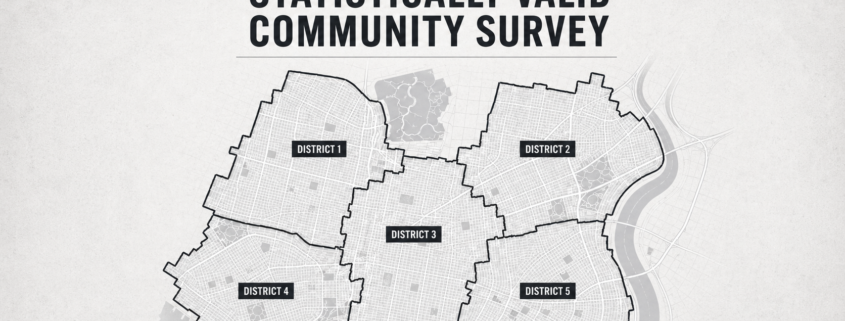
Placing a revenue measure on the ballot is a significant investment of staff time, political capital, and community goodwill. Polling to test the viability of a revenue measure is done to guide next steps. The only way to get this kind of information is by conducting a statistically valid poll of your likely voters.
Determining viability. The primary goal is to answer a simple but critical question: if the governing body places a measure on the ballot, does it have a reasonable chance of success on Election Day? Sometimes the data reveals there is no clear path to victory. Even if this is the case, it will still have spared the agency a costly loss and given you the information on what your voters care about, so you can start explaining why a future measure will help solve that problem.
Structuring the measure. If a measure is feasible, the polling data becomes a blueprint for how to build it. It helps an agency align the tax rate, the duration, and funding priorities with exactly what the community is willing to support, rather than what staff or consultants assume. The data from a poll helps to inform the ballot language.
Building your messaging for education and outreach. The poll will tell you where your agency is excelling and where you are falling short of voter expectations. With this knowledge, you can create the appropriate and responsive outreach content.
Elements of a Revenue Measure Feasibility Poll
Statistically reliable results depend on a few rigorous steps.
| Step | What it involves |
|---|---|
| Target the right election | Different elections bring out different types of voters. The general rule: The bigger the turnout, the better chance of success. Why? Because there are often younger voters, people who don’t own property, or people who fall into other categories that do not think the tax will apply to them. If a voter thinks they will benefit from the tax, but it won’t impact them, they have every incentive to support it. |
| Identify likely voters | Likely voter modeling requires experience with local turnout patterns, voter history, demographics, and the specific election environment. |
| Stratified and random sampling (unique to Probolsky Research) | Probolsky Research employs stratified random sampling at the point of collection. Rather than correcting for demographic imbalances after the fact with post-survey weighting, we build representative balance directly into the sampling design during data collection. This ensures every response reflects a real, verified voter, and in the correct demographic proportion without relying on corrective statistical modeling. . |
| Secure, multimodal outreach | Surveys are distributed by text, email, and telephone to maximize response and accessibility. Digital invitations use PIN-protected links so each respondent can take the survey only once, protecting data integrity. |
Frequently Asked Questions
When should we conduct feasibility polling?
Early – before the governing body commits to placing a measure on a specific ballot. It will tell you if there is a chance and inform the outreach.
What if the poll says the measure cannot win?
Your pollster should have asked the ‘why’ questions so that you can start to do the work that will help you get to a better place with the voters. The poll, while disappointing, should give you the information you need to effectively communicate the agency’s needs. Doing community outreach, writing newsletter and social media content, holding workshops over the following year or two can help you bridge that gap, so next time you poll, your numbers have a good chance of improving.
How is this different from a regular community survey?
A community survey measures resident opinion on services, priorities, satisfaction – it discovers their aspirations for the future of their community. A revenue measure feasibility poll is built specifically around an election: only likely voters are included and the questions center around whether the voters will support a new (or renewed) revenue measure.
Why would you put the opposition’s arguments out there?
The poll should simulate the whole campaign – the supportive arguments and the opposition’s attacks – to give you a realistic read on support. There are residents in every community who will oppose a measure, so their voice must be represented in the research. Testing the opposition arguments is a battle test for how well the measure can stand up to attacks.
Can polling tell us what kind of tax and what tax rate to pursue?
Yes. You can test three to four alternative types of revenue measures in one poll. And you can also test how the level of support shifts based on the monthly or annual cost to the average individual (homeowner, business, visitor, etc.).
Is feasibility polling only for cities?
No. Counties, towns, villages plus water, sewer, solid waste, parks, electric utilities, fire, transportation agencies use them all the time. The same goes for school districts and community colleges. If your agency has tax, fee, or rate-setting authority, a revenue measure feasibility poll should be included in your planning process. Probolsky Research conducts revenue and debt measure feasibility polls for public agencies of all kinds across the country.
Should we conduct a tracking poll?
Yes. But only if you will use the results to inform decision-making. They are best conducted just before the go/no-go moment. Tracking polls test the efficacy of the outreach thus far and verify that the measure is still viable, usually months after the initial poll.
We are a small community, can you poll here?
Yes. Sometimes we need to use mail in addition to telephone and online modes, and even door-to-door canvasing, but no community is too small to poll.
What Experience Should Your Pollster Have?
Your agency stays neutral – but Election Day doesn’t. Your measure will live or die in a campaign environment, so your pollster needs to know how campaigns actually unfold: how opposition arguments spread, how turnout shifts, and how voters behave when filling out their ballot – in the booth or at the kitchen table. Look for a pollster with in-the-trenches campaign experience.
Useful Definitions
| Term | What it means for local government |
|---|---|
| Feasibility study | A survey that provides insight into whether a revenue measure can pass and how to structure it for the best chance of success. |
| Voter poll | A science-based survey of voters, using the data from county election officials |
| Tracking poll | Similar to a voter poll, but conducted later in the process, usually just before the deadline to file for the ballot, to help make the final decision about whether to go or hold for a future election. |
| Likely voter | A person whose voting history suggests they will actually cast a ballot in the specific election being targeted. Pollsters consider other factors such as what else is on the ballot to fully determine the pool of likely voters. |
| Ballot test | A survey question that presents voters with language that closely approximates the question they would see on a future ballot and asks how they would vote. |
| Baseline (initial) ballot test | The first read of support, taken before any arguments or education are introduced. |
| Informed ballot test | A re-test after respondents hear messages, some seemingly positive and others seemingly negative. |
How Probolsky Research Can Help Your Public Agency
- See details at Ballot Measure Feasibility Polling
About Dr. Adam Probolsky
Dr. Adam Probolsky is President of Probolsky Research, which conducts polls and surveys for local governments across the U.S. Adam has also served in government roles at the city, county, and state levels, where he made and oversaw policy related to finance, parks, planning and land use, transportation, and waste & recycling. He was also a sheriff’s department public information officer. He is a Senior Research Fellow for the Drucker School of Management at Claremont Graduate University.
About Probolsky Research
Probolsky Research conducts public opinion research for corporate, election, government, and nonprofit clients. The firm works for public agencies in 29 states from offices in Dallas, Denver, Newport Beach, Pasadena, San Francisco, and Washington DC.