A poll conducted in November discovered that California voters have a distinctly different view from environmental and political leadership on how to address the future of water.
Surface storage (dams and reservoirs) are supported by seventy-two percent of voters.
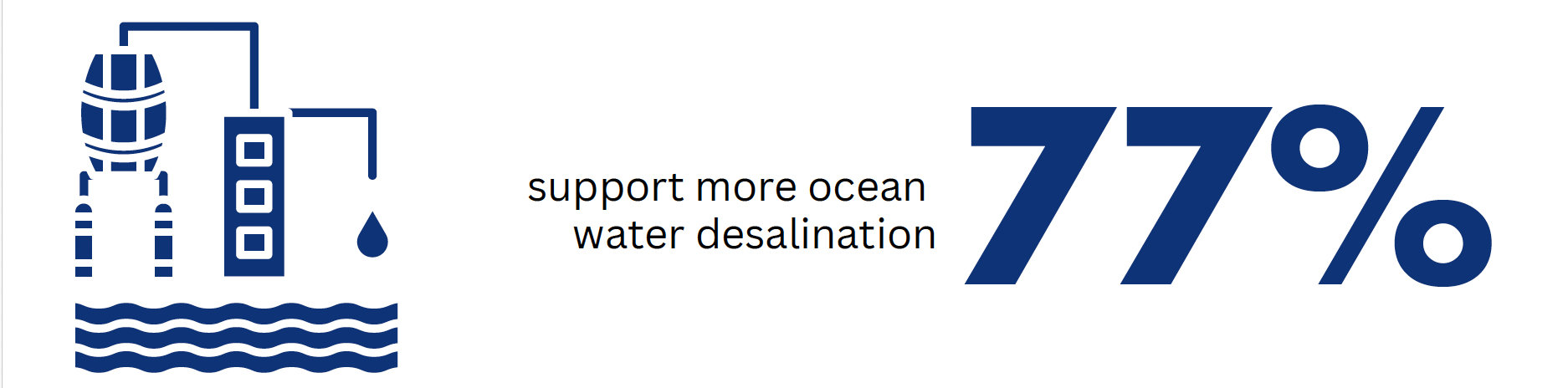
Ocean water desalination is supported by seventy-seven percent of the voters.
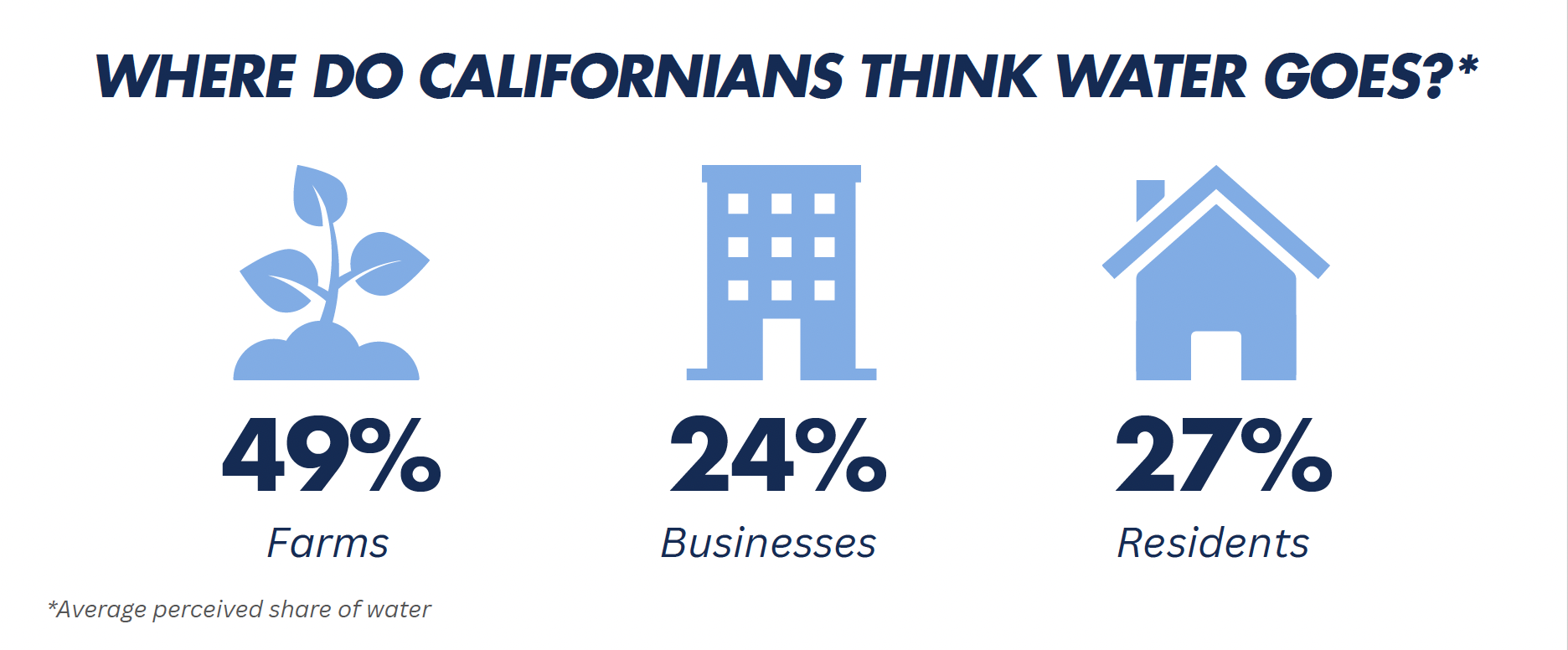
The real number is closer to 80% of the state’s water supply going to agricultural use.
All this adds up to a challenge for the environmental community that is largely opposed to dams and desalination. It may also be an opportunity for supporters of new water infrastructure. They may use these voter sentiments in how they approach funding.
A more complete look at the polling data on water policy can be found here.
https://www.probolskyresearch.com/wp-content/uploads/2025/12/Desal-copy.png500500Probolsky Researchhttps://www.probolskyresearch.com/wp-content/uploads/2024/08/Logo.pngProbolsky Research2025-12-03 07:07:212025-12-03 07:12:11The Voter – Policymaker Divide on Water
Most people do not understand public affairs, so Dr. Adam Probolsky wrote this primer:
/// Many executives are great at business, but uninformed about public affairs and political risk because they have never had to know how to navigate government
/// The need to engage with government is extending to broader groups of industries – to head off or fix a problem / or for prospective opportunities
/// There is a public affairs approach that successful companies use and can be adopted to great effect, just ask, any public affairs professional can share the typical roadmap
/// This is not comms, lobbying, marketing, market research, or PR – public affairs has elements of all of them, but don’t assume your existing team can “just handle it”
/// Public affairs practitioners have worked in politics or possibly government – there is no secret sauce, but when you have a heart attack, you want the board-certified cardiologist, not the school nurse – the same goes for public affairs
/// It may sound unoriginal, but the first step is to get a strong consulting team in place
/// 99% of public affairs happens at the state and city/county level, it’s not always as exciting or sexy as what happens nationally
Probolsky Research partners with consultants that operate in the public affairs space. We love collaborating. We love winning.
Local government staff have a dual role – their functional job and the job of keeping their residents happy. No one else has to work under those condition. Sure, corporate executives answer to shareholders, but not with the intensity and proximity that residents have to City Hall.
Yet many agencies instruct staff to leave politics outside the building – not just their personal politics. My new piece for the International City/County Managers Association (ICMA), “A Strict Politics – Policy Divide Is Holding Your Agency Back,” shows why limiting staff’s ability to watch and consider the politics of the day is bad for the agency.
The article explains how politics works as an early warning system.
I outline a routine that requires no extra headcount: track narrative shifts, assign a lead, and circulate a one-page memo each week. This way staff gain situational awareness.
Probolsky Research follows the same approach when guiding agencies through surveys, focus groups, and message testing. We help staff see the story behind the numbers, then translate that story into policy choices that withstand public scrutiny.
A Strict Politics–Policy Divide Is Holding Your Organization Back
If your organization is facing a political threat, you do not fight it with silence—you fight it with strategy.
By Dr. Adam Probolsky, president of Probolsky Research and senior research fellow with Claremont Graduate University’s Drucker School of Management
I have yet to meet a local government staff member that could not read the room. But when their hands are tied behind their backs—told to avoid politics at all costs—they are not operating at peak performance. Staff are not confused about the differences between political and public policy disciplines. They understand the unique dynamics between thinking politically and acting politically.
They know it means anticipating what might trigger backlash before it shows up on an agenda.
For example, flagging a new fee before it appears on an agenda where activists are likely to label it a “tax” is thinking politically and giving everyone involved the opportunity to prepare. Staff are not going to seek an endorsement of the fee from the local county party chairman.
Politics is about power: getting it, keeping it, and using it to win. Public policy is about outcomes: what laws, regulations, or programs actually say and do. The two often intersect. Both are grounded in research, data, and stakeholder input—we hope.
Politics as an Early Warning System
What is often overlooked in the public policy realm is the anticipatory value of politics.
Political systems theory frames politics as a connected feedback loop. Citizens express needs and preferences (inputs) through elections, political speech in all its forms, and media consumption patterns. Politicians interpret those signals and attempt to translate them into public policy (outputs). When expectations are not met, the public responds through disengagement, outrage, or votes.
What This Means for Staff
Staff’s focus on statutory obligations or program design is important. But dismissal of the broader political environment is causing your agency to miss early signals of change. This is not about partisanship. It is about situational awareness. Politics can tell us what people believe is happening, even if it is not true.
Staff may pride themselves on evidence-based thinking, but politics operates on emotion, identity, and perception. Research in behavioral science consistently shows that people make judgments based on recent, vivid events, not long-term data. Policy professionals who do not account for this disconnect risk being right but irrelevant, sharing the truth but still losing trust.
Monitoring, Not Reacting
The answer is not for staff to become political operatives. It is to treat politics like a real-time sensor network. This means tracking the origin of negative public comments—sometimes valid concerns, sometimes personal frustration. Monitoring social media not just for sentiment, but for narrative shifts. Knowing which local or regional issues are heating up, even if they are not “yours” yet.
Taking Action
Every public agency needs a top-down directive that makes caring about, learning about, and strategizing over politics’ impact on local policy the norm, not a taboo activity to be hidden.
Having a clear, consistent approach to tracking the political environment does not require a new hire. It requires assigning responsibility and making political awareness part of normal operations.
That might mean:
Reading statewide and regional political blogs, not just waiting for association updates.
Monitoring legislative agendas and committee activity, not just relying on lobbyist summaries.
Watching for local versions of national debates before they surface at your public meetings.
This work can live within your public affairs or public information offices, or be assigned to a management analyst intern. The point is: it needs to be someone’s job, and everyone’s shared awareness.
Consider creating a short political signals memo. Think one page, once a week. No spin, just intelligence. A few bullet points on:
Community sentiment shifts.
Stakeholder activity worth watching.
Viral local issues or narratives.
Legislative developments that could ripple your way.
Some agencies already have a version of this, but keep it confined to the executive team. That is a mistake. Siloed awareness delays coordinated response. Bring a broader group into the picture. Give them the foresight they need to avoid surprises and plan smart.
This is not about playing into the headlines. It is about anticipating impact. The goal is to be aware. Strategic. Less reactive.
Politics is not always rational. But it is rarely random. People expressing fear, anger, or distrust are data points. If your agency is facing a political threat, you do not fight it with silence, you fight it with strategy.
https://www.probolskyresearch.com/wp-content/uploads/2025/07/Screenshot-2025-07-31-at-2.22.20-PM.png11841588Probolsky Researchhttps://www.probolskyresearch.com/wp-content/uploads/2024/08/Logo.pngProbolsky Research2025-07-31 21:24:082025-10-14 07:25:20Politics ≠ Political
From homelessness and affordable housing to fixing public transit, protecting subway riders, and improving education and public safety, Democratic Primary voters in New York have high expectations that are not being met.
The poll also finds that Mayor Adams has a narrow path to re-election and that Governor Cuomo would be an instant frontrunner should he decide to get into the race.
Call or text Dr. Adam Probolsky at (949) 697-6726 for comments or more information about the poll.
Methodology
From January 7 to January 13, 2025, Probolsky Research conducted a survey among likely 2025 New York City Democratic Primary Election voters. The sample was compiled from voter file data and matched to the demographics of likely voters. A stratified random sampling methodology was used to ensure accurate representation.
The survey was administered by phone (33%) and online (67%). Phone interviews were conducted via landline (32%) and mobile (68%), while online participants were invited by email (50%) and text message (50%). Respondents could choose their preferred language: Cantonese (<1%), English (94%), or Spanish (6%).
The survey has a margin of error of +/-5% citywide and +/-5.8% for Manhattan oversample, CCD 28 oversample, and CCD 39 oversample, all with a 95% confidence level.
These results are being released for public interest only.
Probolsky Research is a nonpartisan Latina and woman-owned market and opinion research firm with corporate, election, government, and non-profit clients.
https://www.probolskyresearch.com/wp-content/uploads/2025/01/NYC-Poll-image-copy.png500500Probolsky Researchhttps://www.probolskyresearch.com/wp-content/uploads/2024/08/Logo.pngProbolsky Research2025-01-27 20:27:312025-01-31 21:47:04New Yorkers Have a Long List of Demands
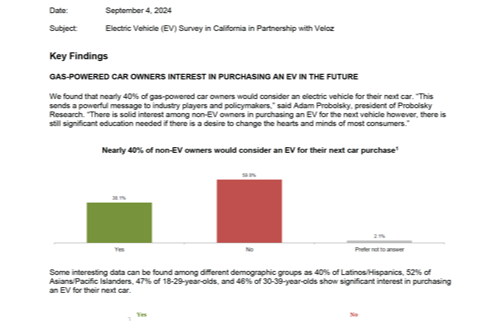
We are at a pivotal moment for electric vehicle (EV) adoption – the data suggest consumers are warming to EVs. When 38% of consumers want something, it is not going away.
Call or text Adam Probolsky regarding this research – 949-697-6726.
Probolsky Research is a Latina- and woman-owned market and opinion research firm with corporate, election, government, and non-profit clients.
This survey was conducted in partnership with Veloz.
Our results presentation can be viewed below.
https://www.probolskyresearch.com/wp-content/uploads/2024/09/Veloz-image-square.png500500Probolsky Researchhttps://www.probolskyresearch.com/wp-content/uploads/2024/08/Logo.pngProbolsky Research2024-09-05 11:26:152024-09-05 11:26:16Many consumers see electric vehicles as a viable option
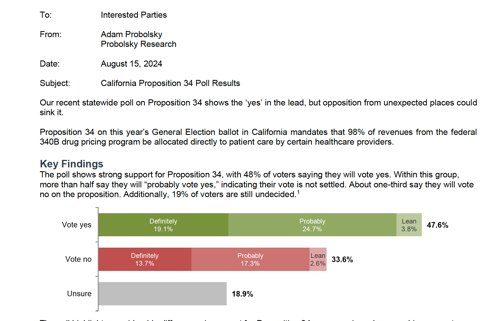
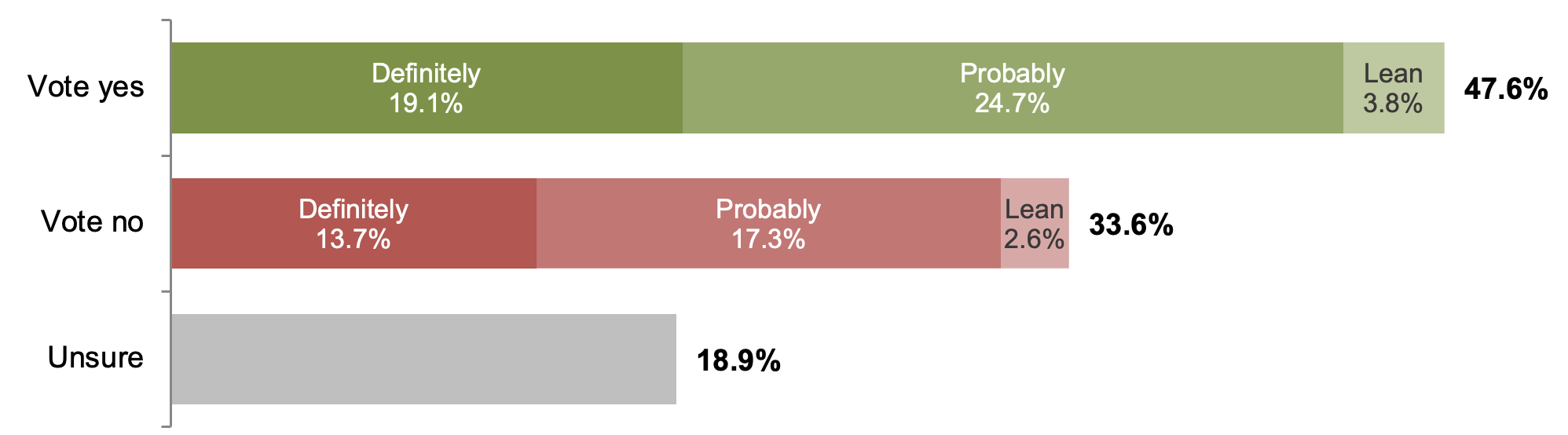
Probolsky Research conducted a statewide poll and asked likely voters how they would vote on Proposition 34 on the November General Election ballot. The ‘yes’ vote is winning but there are signs of weakness among certain demographic groups that the ‘no’ campaign might exploit. See memo below for details.
Contact Adam Probolsky at (949) 697-6726 for comments or more information about the poll.
Methodology
From July 31 to August 8, 2024, Probolsky Research conducted a poll among 900 likely 2024 General Election voters. The sample was drawn from voter files compiled by election officials across all 58 counties in California, using a stratified random sampling methodology to ensure it accurately reflects the demographic composition of likely 2024 General Election California voters. The poll was administered by phone (33%) and online (67%), yielding a margin of error of +/-3.3% with a 95% confidence level.
We did not have a client associated with this research. It was conducted for public interest only.
Probolsky Research is a nonpartisan Latina and woman-owned market and opinion research firm with corporate, election, government, and non-profit clients.
https://www.probolskyresearch.com/wp-content/uploads/2024/08/Prop-34-image.png500500Probolsky Researchhttps://www.probolskyresearch.com/wp-content/uploads/2024/08/Logo.pngProbolsky Research2024-08-15 22:18:292024-08-15 23:11:10Yes on CA Prop. 34 Shows Signs of Passing
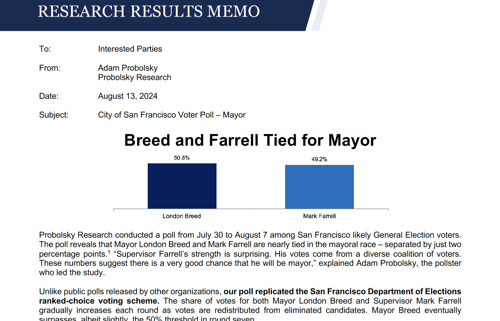
San Francisco uses ranked-choice voting. Ours is the only public poll that fully adheres to how the City’s Election Department counts the votes.
“Farrell’s strength this early in the election cycle is a very good sign for his campaign,” explained Adam Probolsky, president of Probolsky Research. “While tied for the lead, Breed has limited upside potential — she needs to hold on to every vote she has. Farrell has room to grow his support base from voters who are currently choosing other challenger candidates.”
Contact Adam Probolsky at 949-697-6726 for comments or additional background.
This poll was funded by the San Francisco Deputy Sheriff’s Association Political Action Committee.
Probolsky Research is a non-partisan, Latina and woman-owned market and opinion research firm with corporate, election, government, and non-profit clients.
https://www.probolskyresearch.com/wp-content/uploads/2024/08/Memo-image-copy.png500500Probolsky Researchhttps://www.probolskyresearch.com/wp-content/uploads/2024/08/Logo.pngProbolsky Research2024-08-14 19:52:232024-08-14 19:52:24Race for San Francisco Mayor Tied
It’s easy for local government to get caught up in the narrative that all government is wasteful or corrupt or both. Those of us involved in local government know that neither is largely true, but how can we overcome this perception?
Build something permanent.
When you build something that the taxpayers can see, touch, or walk on, you are building trust. When you build something that is going to last 40 years or longer, you are building trust.
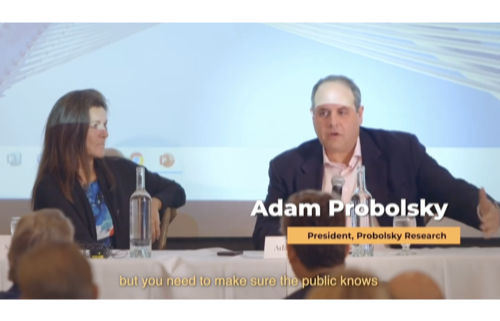
Adam Probolsky recently spoke about this at the Southern California Water Coalition.
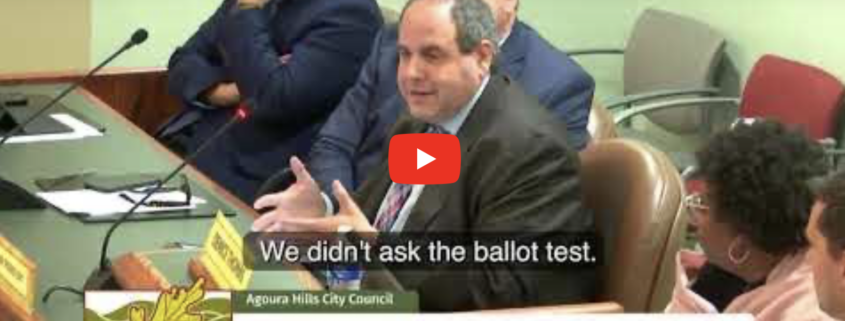
https://www.probolskyresearch.com/wp-content/uploads/2024/04/Adam-Probolsky-presents-to-the-Agoura-Hills-City-Council.png8901584Probolsky Researchhttps://www.probolskyresearch.com/wp-content/uploads/2024/08/Logo.pngProbolsky Research2024-04-03 17:24:142024-04-03 17:24:15Adam Probolsky presents to the Agoura Hills City Council
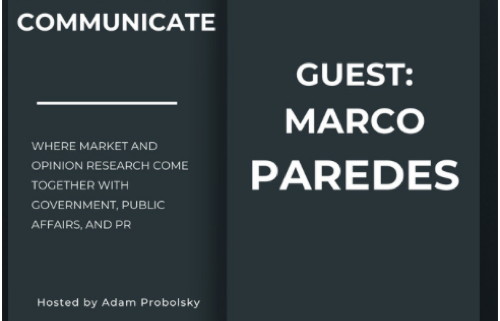
This episode features Marco Paredes, attorney/lobbyist and go-to guy for Florida advocacy. We talked about how he ended up in Tallahassee, his lobbying style, and his popular weekly newsletter about the Florida legislature that he started during the pandemic – Rotunda Report.
Marco Paredes is a Shareholder and serves as the Director of Government Affairs for the law firm of Stearns Weaver Miller in Florida. Marco helps clients formulate and execute strategies to achieve their desired policy goals by advocating for their business interests and priorities before state government.
https://www.probolskyresearch.com/wp-content/uploads/2023/09/Marco-Paredes.png500500Probolsky Researchhttps://www.probolskyresearch.com/wp-content/uploads/2024/08/Logo.pngProbolsky Research2023-09-28 17:10:562023-09-28 17:24:20LISTEN: Insights to Communicate Podcast with guest Marco Paredes, hosted by Adam Probolsky